Two hospice nurses caring for a patient in bed holding hands
  • 5802 Story Headers (1)

    Staff Spotlight on Provider Relations


    Trevor Combs Channels Compassion

    It has been almost nine years since Trevor Combs left his position as an account manager at a uniform company to join Crossroads in Dayton. 

    His wife, a director of nursing in a long-term care facility, recommended that Trevor consider a professional move to a hospice company. In her role she meets regularly with hospice representatives in the provider relations role.

    5802 Story Headers (1)

    Staff Spotlight on Provider Relations


    Trevor Combs Channels Compassion

    It has been almost nine years since Trevor Combs left his position as an account manager at a uniform company to join Crossroads in Dayton. 

    His wife, a director of nursing in a long-term care facility, recommended that Trevor consider a professional move to a hospice company. In her role she meets regularly with hospice representatives in the provider relations role.

    Soon after her suggestion Trevor joined Crossroads as a provider relations representative. According to Trevor, he found a very good fit, thanks to his wife.

    Coming from his previous job as an account manager for a uniform company, Trevor shared that there are more similarities across the positions than you might expect, “building and strengthening relationships with clients goes hand-in-hand for both roles.”
    Crossroads Provides the Best Care

    Trevor said what sets Crossroads apart from other end-of-life care providers in the highly competitive Dayton market is simply its outstanding hospice care. 

    High-quality service is Trevor’s top priority. He said, “I was called to do this because we provide the very best end-of-life care.” Trevor cares deeply for patients living in their homes with their families. 

    Trevor also has a place in his heart for patients in long-term care. “We're there to support both the facilities and residents because they become family to each other.” 

    Trevor is most proud of Crossroads Even More Care (EMC) Watch program and the concept that no one should die alone. 

    The hospice and palliative care field is constantly evolving. Keeping up with demands and specific needs within care facilities and in patients’ homes is part of Trevor’s job. “I help Crossroads keep up with industry trends,” he said.

    Working in end-of-life care and educating people about hospice services requires a tremendous amount of strength, empathy and compassion. “It’s tough, but valuable and rewarding,” Trevor said. 

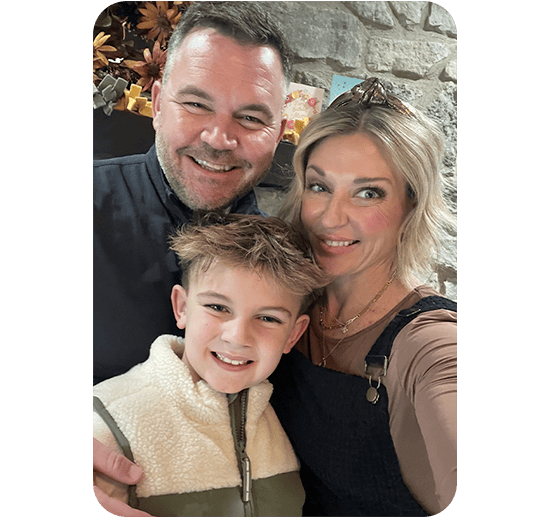
    Outside of work, Trevor is a husband, father, friend and coach to his son, a fourth grader who plays football, basketball and baseball. Trevor also loves golf. Crossroads looks forward to celebrating Trevor’s 10th anniversary in 2027.


  • Path To More

    Willie’s Gift: Sitting with Death

    By Danny Gutknecht

    There's nothing more disturbing than the funeral director tapping you on the shoulder to let you know your viewing time is over. The whole process has a fast-food feel to it. The moment someone we love dies, they go from a person to something that requires professional management: removed, refrigerated, prepared, transported, displayed briefly, disposed of.

    Death as a logistics problem: package, timetable, transaction, completion. We've made grief fit the recipe too. The grief handbooks turned personal and cultural rituals into empty turtle shells, where the real encounter becomes a managed transaction.

    Path To More

    Willie’s Gift: Sitting with Death

    By Danny Gutknecht

    There's nothing more disturbing than the funeral director tapping you on the shoulder to let you know your viewing time is over. The whole process has a fast-food feel to it. The moment someone we love dies, they go from a person to something that requires professional management: removed, refrigerated, prepared, transported, displayed briefly, disposed of.

    Death as a logistics problem: package, timetable, transaction, completion. We've made grief fit the recipe too. The grief handbooks turned personal and cultural rituals into empty turtle shells, where the real encounter becomes a managed transaction.

    At one point we knew better. In colonial America people died at home. The family washed and dressed the body, laid it out in the house, and friends came to keep vigil through the night, eating, drinking, talking, and mourning together in what was called a house of mourning.

    When Willie Lincoln, President Lincoln's son, died in the White House at 11 years of age, his body lay in the Green Room for four days. Elizabeth Keckly, who helped wash and dress Willie, said she had never seen a man so bowed down with grief. The President would uncover his son's face, gaze at it long and earnestly, and openly weep. And there are accounts of Lincoln having Willie's coffin opened so he could look upon his son again.

    Today we'd ask whether Lincoln was stuck, whether he had adequately "processed" the loss, whether he needed to "move on." We've turned grief from an ongoing relationship with the deceased into a "condition" the grieving person "needs to work through." And yet Lincoln, perhaps one of the greatest leaders we've known, is a very poor fit for what we think about grief. He clearly refused closure, and he also allowed his refusal to change him.

    To see how, we need to look at his language.

    Before Willie, Lincoln's intellect worked like an exceptional lawyer's: establish the facts, find the contradiction, define the rule, infer the action. He approached challenges with a belief: if you construct the argument correctly and locate yourself within reality, you'll find a way through. His speeches — the House Divided, Cooper Union, the First Inaugural — are intelligent, legalistic, argumentative, and all show this clearly.

    The sermon at Willie's funeral was on Divine Providence. Later that year, on a scrap of paper his secretaries would title "Meditation on the Divine Will," Lincoln was writing about the war in the language of someone who has lost a child. How do I understand something devastating, irreversible, and beyond my control?

    You cannot lawyer a child back into existence. That December he told Congress that "the dogmas of the quiet past are inadequate to the stormy present," and that we must "disenthrall ourselves": become free of the organizing ideas that have imprisoned perception.

    He didn't stop reasoning; it looks like he just stopped believing that reasoning to certainty was the solution. "I claim not to have controlled events," he wrote, "but confess plainly that events have controlled me." He saw that both sides believed they were doing the will of divine providence and considered that maybe divine will had completely different intentions than either side.

    He also learned what to do with his grievances, which in the past had clearly driven his rhetoric. Lashing out at a general in a letter, then not sending it. His compulsion to resolve contradictions ceased, and his language showed that he was increasingly able to inhabit them without letting one side annihilate the other.

    And compare the First Inaugural with the Second. Four years and enormous amounts of death later, the Second is almost metaphysical. He frames the entire nation as sharing the sin of slavery and then closes: "with malice toward none; with charity for all; with firmness in the right." Lincoln refused an explanation where one side simply possessed the right answer.

    Did Lincoln know any of this before Willie? Rationally, of course. But rational knowledge is not the same as what is gained from contact, from working with it internally. That is the gift death offers: what you do when the rational mind meets something it cannot control by explaining it.

  • 5906 GGP Header

    Beyond October

    Being Vigilant about Breast Cancer Awareness

    Everything goes pink in October. It’s the time of year when buildings display pink lights at night, fountains are dyed so they bubble pink foam and football players showcase pink gloves and cleats. 

    But Breast Cancer Awareness Month is about so much more than the color pink. It’s about raising awareness about a disease that affects millions of people and encouraging individuals to take steps toward early detection. 

    According to The American Cancer Society, one out of eight women will be diagnosed with breast cancer in their lifetime. The organization also estimates that more than 42,000 women will die from breast cancer in 2026.

    5906 GGP Header

    Beyond October

    Being Vigilant about Breast Cancer Awareness

    Everything goes pink in October. It’s the time of year when buildings display pink lights at night, fountains are dyed so they bubble pink foam and football players showcase pink gloves and cleats. 

    But Breast Cancer Awareness Month is about so much more than the color pink. It’s about raising awareness about a disease that affects millions of people and encouraging individuals to take steps toward early detection. 

    According to The American Cancer Society, one out of eight women will be diagnosed with breast cancer in their lifetime. The organization also estimates that more than 42,000 women will die from breast cancer in 2026.

    Breast Cancer Awareness is Now Universally Recognized

    Breast Cancer Awareness Month was co-created in 1985 by the American Cancer Society and a British chemical manufacturing company, Imperial Chemical Industries. 

    It started as a week intended to educate women about best screening practices. Today, 41 years later, with its signature pink ribbon, breast cancer awareness is recognized by organizations and companies worldwide each October.

    Early Breast Cancer Detection is Best

    While most people are aware of breast cancer, many still neglect to take steps to catch breast cancer in the early stages. When breast cancer is found early (also called the localized stage,) the 5-year survival rate is 99 percent, according to the National Breast Cancer Foundation. 

    While you can't prevent breast cancer, you can be aware of the ways to catch it in the early localized stage. Here are three steps to reduce your risk:

    Annual mammogram - These should start at age 40. Women under 40 with a family history of breast cancer or other risk factors should speak to their doctor about the best time to begin annual mammograms.

    Clinical breast exam - A clinical exam should be performed by a trained medical professional at least every three years beginning at age 20 and annually after age 40.

    Breast self-exam - Performed monthly, self-exams can detect changes quickly. Forty percent of diagnosed breast cancers are detected by women who feel a lump and report it to their doctor.

    It’s never too late to put an early detection plan in place. You can start this October or any time.

Vital Signs

This week's question:

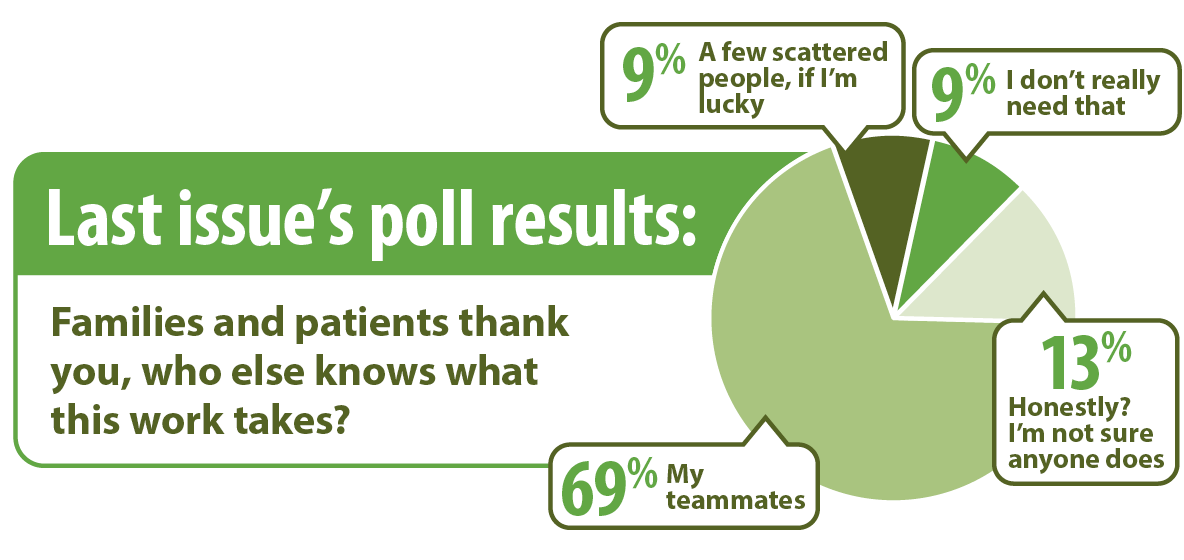
Watching people die: How has it changed you?
(Responses are anonymous and used to help improve the organization.)


WOW!

Why not recognize a coworker for a job well done?

Congratulate August’s WOW! Card recipients:

Cincinnati

Danielle Walker, STNA
Dawn Bradley, SW
Ed Blankenship, PR
Linda Haywood, Recep
Natalie Girsha, RNCM
John Reynolds, CH
Kristina Wilson, CD
Lindsey Seiber, QRT RN
Megan Robertson, RNCM
Scott Looney, QRT RN

Cleveland

Volonda Williams, HA
Megan Hughes, RN
Teena Orr, LPN

Dayton

Richard Fitzwater, CH
Mark Lafferty, CH
Tyree Horn, QRT LPN
Shawnta Parker, QRT STNA
Cierra Caitlin, DS STNA
Tami Jacobs, SW
Jack Thompson, BC
Loretta Haney, STNA
Chiquita Berry, CD
Heather Sheets, SW
Richard Fitzwater, CH
Aataya Berry, RN CM
Stacey Evans, DS STNA
Paula Owen, MR
Trevor Combs, PR
Christopher Radcliffe, PR    
Cynthia Brooks, HL
Leanne Lane, RN
Alicia Ritter, RN CM
Faith Richardson, DS LPN
Tina Lambert, QRT RN
Tyree Horn, QRT LPN
Ceara Mebane, DS STNA
Charise Madden, DS STNA
Cierra Caitlin, DS STNA
Sheree Crable, DS STNA
Olivia Engram, DS STNA
Shawnta Parker, QRT STNA
Jerrica Pannell, QRT STNA
Kevin Shurts, QRT STNA

Northeast Ohio

Alanna Wilson, RN
Alexis Woods, RN
Allysen Grimes, SSD
Allyson Sinkovich, RN
Amanda Deckerd, RN
Amanda Friend, MR
Amy Mayle, STNA
Andrea Foster, RN
Andrew Harris, STNA
Ben White, PR
Britney Zenallis, IC
Caitlin Ford, BC
Cheryl Courrier, RN
Chris Carter, STNA
Christina Shepper, Billing
Christine Wilson, SW
Ciarra Shaffer, RN
Connie Shy, RN
Dan Renicker, RN
Darrial Rampey, STNA
Dawn Benson, RN
Doria Kisling, SW
Elizabeth Rardon, STNA
Emily Hathaway, IC
Eric Tiell, STNA
Erika Knopp, ACD
Hallie Leonard, RN
Heather English, STNA
Heather Richmond, RN
Holly Fogle, MR
Jackie Roby, RN
Jamie Layton, STNA
Jane Piehl, CH
Jason Grassie, RN
Jodi Burroughs, AED
John Morgan, CH
Joy McIntosh, STNA
Julie Compan, STNA
Julie Lang, RN
Kaela Saintenoy, MR
Kali Metz, TL
Katelyn Horton, STNA
Kelly Fogel, PR

Kelsey Tilton, RN
Kelsie Vrable, SW
Kenna Peterson, SW
Kerrie David, MD
Latonia Branch, STNA
Laura Russell, BC
Marianna McLaughlin, RN
Megan Cox, LPN
Melissa Hmidan, RN
Mike Burkhardt, SW
Morgan Gray, LPN
Mostafa Mirhaidari, MD
Olivia Coontz, SW
Pat Slater, CH
Pierce Norman, SW 
Renee Morgan, CD
Riley Mizer, RN
Robin Rossiter, MR
Sara Foster, LPN
Stephanie Grindel, RN
Stephanie Killen, RN
Taylor Smith, RN
Tempie Porter, MR
Tianna Mahaffey, STNA
Tiffany Shull, STNA
Tim Jensen, CH
Tongela Jackson, STNA
Traci Sechrist, STNA
Tricia Woodside, GOAD
Tyrah Jeter, SW
Valerie Fausnight, LPN


Philadelphia

Holli Farrow, BRV
Christian Bennett, CH
Patrick Loughlin, SW
Christian Bennett, CH
Crystal Hosier , BRV
Jasmine Greene, MR
Monica Kneisler, IC
Vera Hanson, CNA
Mislie Cantave, CNA
Lisa Keeney, RN
Casey Dombrowski, MR
Joe Matonius, Acct
Josh Hwang, CH

Ideas, Comments, Questions?

Please provide us with your feedback using this form.